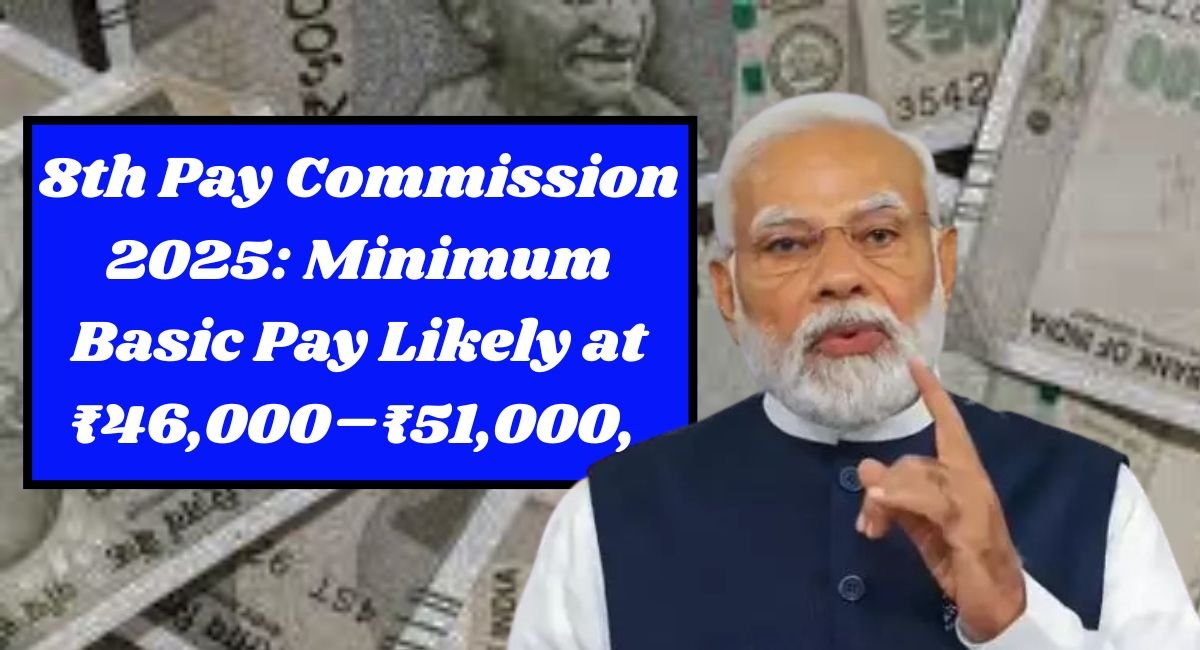
Given additional issues and expert projections, the 8th Pay Commission in 2025 becomes one of the top contenders for policy discussion. Expectedly for central government employees, the increase would bring the minimum pay to around ₹46,000-₹51,000/month, a significant increase from the amount of ₹18,000 that the 7th Pay Commission had introduced. The implication of the revision, to be fast adopted and would touch such figures in almost 50 lakh employees’ and nearly 68 lakh pension-holders’ bank accounts, is changing income levels in the Indian public sector.
Key Highlights of the 8th Pay Commission, 2025
- Minimum Basic Pay: Increase in expected minimum basic pay to ₹46,000-₹51,000
- Current Basic Pay: ₹18,000 under the 7th Pay Commission
- Beneficiaries: More than 1.1 crore employees and pensioners
- Expected date of completion: about mid-2026, upon approval and notifications
- The impact on a pension: Increasing pensions proportionate to the increase
- Focus on inflation: Greater adjustment due to shift of the cost-of-living current
Why the Proposed Hike Is Important
Income will rise owing to the proposals for stimulating both the economy and purchasing power. Since expenditure increases, buying gets accelerated at the same time leading to growth or development for the home country’s residing or working people.
Moreover, this production is unique; as per time, it is durable and can be exchanged for other commodities or even the basic producer good in case of an emergency.
This is why, as in the above petition, the introduction of the new Court Fees Act (2017) will increase alimony and therefore be a deterrant for getting a divorce.

This clause, in particular, can ease the cruise subsidy policy for the island economy; furtherly, one issue includes allowing the rebate for the 150 wt vehicles carrying the containers inside commercial buildings, which currently are 1800 in total.
Expected Impact on the Economy
Enhancing salary on a large scale could have serious implications for the economy. Economists believe that upping salaries in fact incites consumer consumption which benefits sectors of housing, automobiles, consumer goods and services. From experience, an explanation of the higher disposable income among government employees often leads to a stronger domestic demand in terms of supporting growth of the overall economy.
New Snapshots to compare
| Aspect | 7th Pay Commission | 8th Pay Commission (Proposed) | Impact |
|---|---|---|---|
| Minimum Basic Pay | ₹18,000 | ₹46,000–₹51,000 | Massive salary jump |
| Beneficiaries | 50 lakh employees + 68 lakh pensioners | 1.1 crore total | Nationwide impact |
| Implementation | From 2016 | Expected 2026 | Major structural reform |
| Pension Revision | Linked to pay | Significantly higher | Better retirement security |
| Inflation Adjustment | Limited | Stronger consideration | Improved living standards |
What the Experts Say about this:
The labor unions consider these as very welcome figures, seeing that employees groaned under inflation. Economists predicted a push for growth but warned that the government would feel pressure over increased fiscal liabilities. Budget pundits define the ultimate place above employee well-being as knitting further enhanced recommendations with an eye on ever-increased wages versus realisation of fiscal restraint.
So What’s Next?
Economic projections were very popular in 2025 discussions, with the 8th Pay Commission recommendations still under the debate. Once the cabinet ratified the Pay Commission’s recommendations and is passed along with any nuances, formal notification and implementation happens, ideally set up around 2026.

Conclusion
The launching of the 8th Pay Commission 2025 in India can be a very big stage in terms of movement towards reform in salary and pensions: just now a base pay of ₹46,000–₹51,000 has been sanctioned by which explanation can be provided. It should get a whirlwind of relief for employees, augmenting retirees’ pensions, and massively contribute to the economy. The government’s final decision will determine what the next decade will be about concerning public sector compensation.